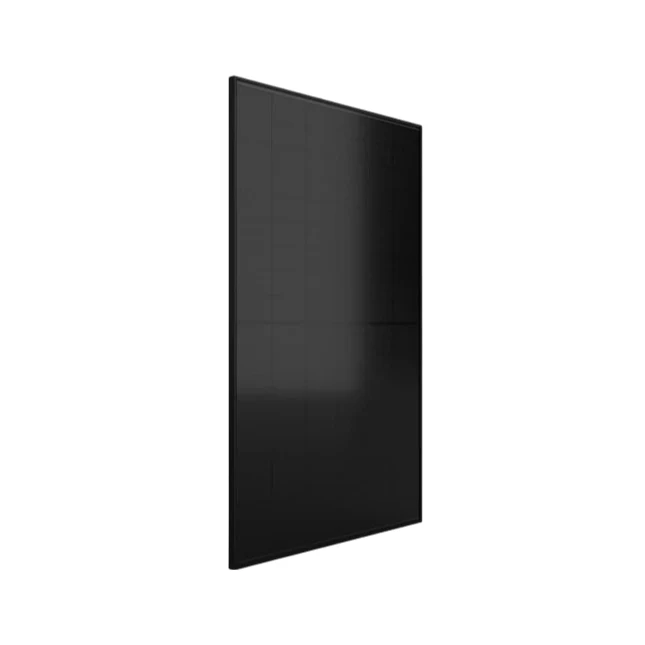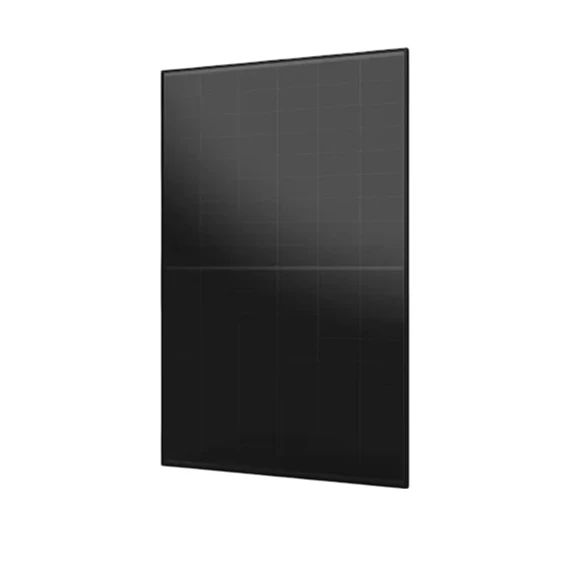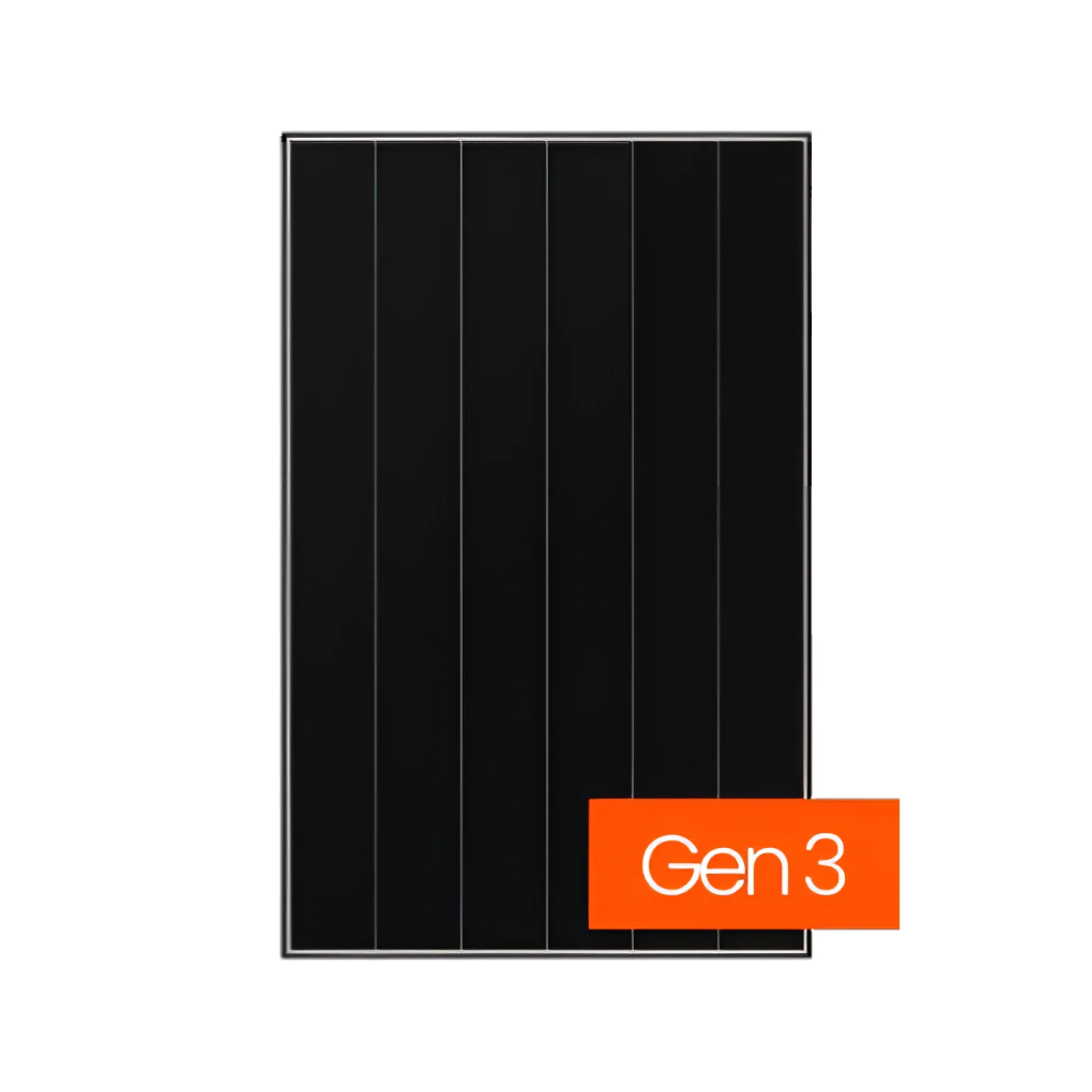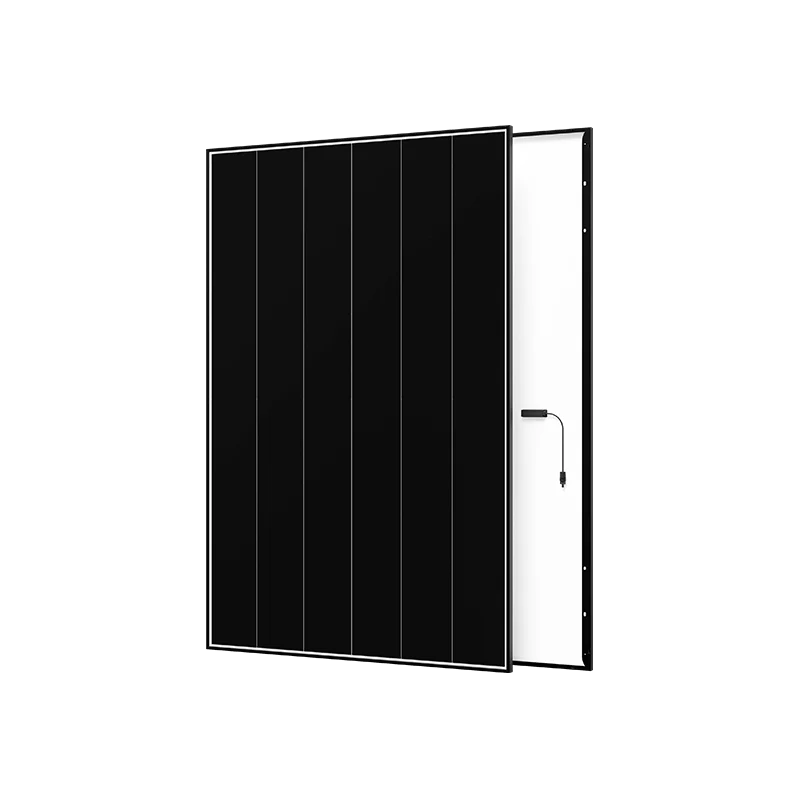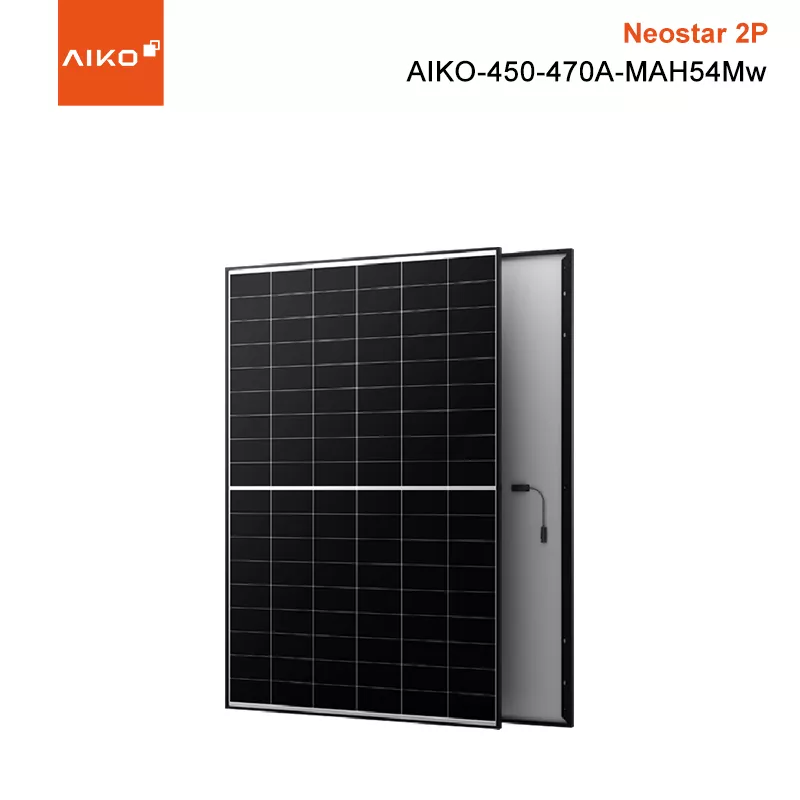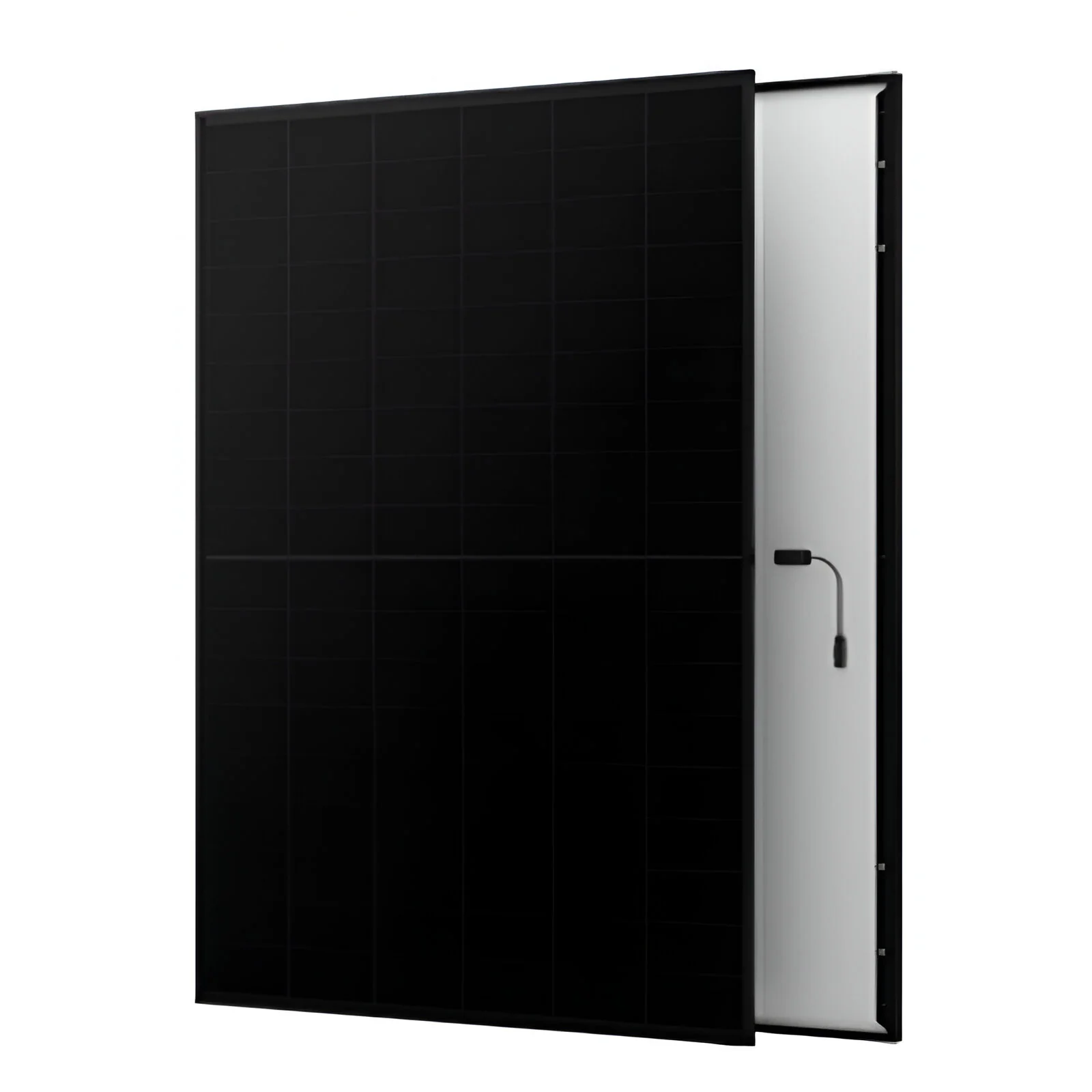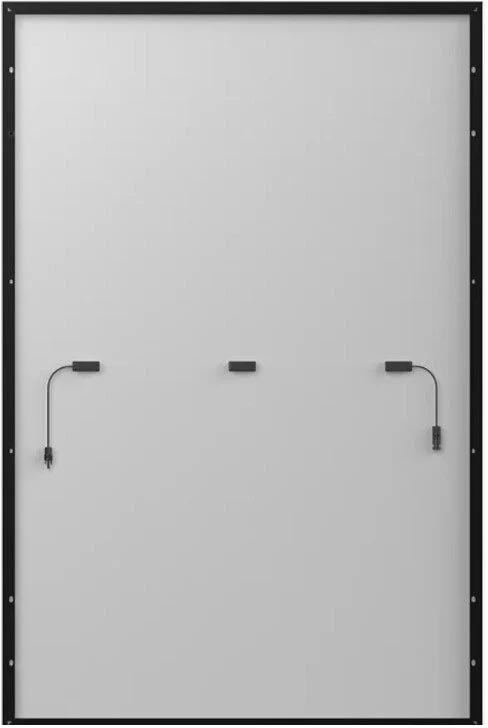
Aiko Neostar Solar Panel 3S 480W N-Type ABC, 54 Cell, Mono Glass All Black, Gen 3
AIKO Solar | MPN: AIK-A-MCE54-480-AB-G3 | MCS Reference: MR 50677721 0001/1072
The AIKO Neostar 3S 480W Gen 3 is the latest iteration of AIKO's all-back-contact N-type solar module — a panel that holds a genuine claim to the highest module efficiency commercially available for residential rooftop use. At 24.0% efficiency from a 1,762 × 1,134mm footprint, it produces more power per square metre than virtually any other panel in its class, making it the natural choice for rooftops where space is limited and maximum output is the priority.
Gen 3 introduces two key technical advances over the previous generation: Precision Overlap Soldering, which eliminates the inactive gaps between cells that reduce usable area on conventional modules; and a fully bezel-less all-black front surface that combines with hidden rear conductors to create a panel that is both visually distinctive and electrically superior. The result is a 15–20kW uplift at system level compared to Gen 2 — not from a larger panel, but from better use of the same roof footprint.
MCS listed and shipped from UK stock, the Neostar 3S 480W is compatible with all mainstream string inverters and qualifying battery storage systems for SEG tariff and Smart Export Guarantee eligibility.
What Makes AIKO ABC Different
All Back Contact (ABC) Cell Architecture
In a conventional solar cell, the metal contacts that collect electrical current run across the front surface — blocking a portion of the incoming light. In AIKO's ABC design, all electrical contacts are moved to the rear of the cell. The entire front surface is available for light absorption, with no busbar shading losses whatsoever. This is the fundamental reason for the Neostar's industry-leading efficiency — it is not a marginal improvement, but a structural advantage over every busbar-based technology including PERC, HJT and TOPCon.
N-Type Silicon – Lower Degradation by Design
N-type silicon is inherently free from light-induced degradation (LID), the performance loss that affects P-type cells in the first months of operation. AIKO guarantees first-year degradation of no more than 1%, followed by no more than 0.35% per year from year 2 onwards — reaching a guaranteed minimum of 90.6% of rated output at year 30. Over the full warranty period this translates to meaningfully more lifetime energy yield than a panel with a higher first-year degradation or steeper annual decline.
Cell-Level Partial Shade Optimisation — Unique to AIKO
Conventional string diode bypass protection operates at the cell-string level — when one string is shaded, the bypass diode sacrifices the entire string to protect the circuit. AIKO's ABC architecture enables partial shade optimisation at individual cell level, meaning shading from a chimney, aerial, tree branch or soiling only affects the specific cells that are shaded, rather than triggering a bypass across a larger section of the module. This is unique to ABC technology and is the reason AIKO panels consistently outperform datasheet expectations in real-world UK conditions, where partial shading is common.
Precision Overlap Soldering — Gen 3 Exclusive
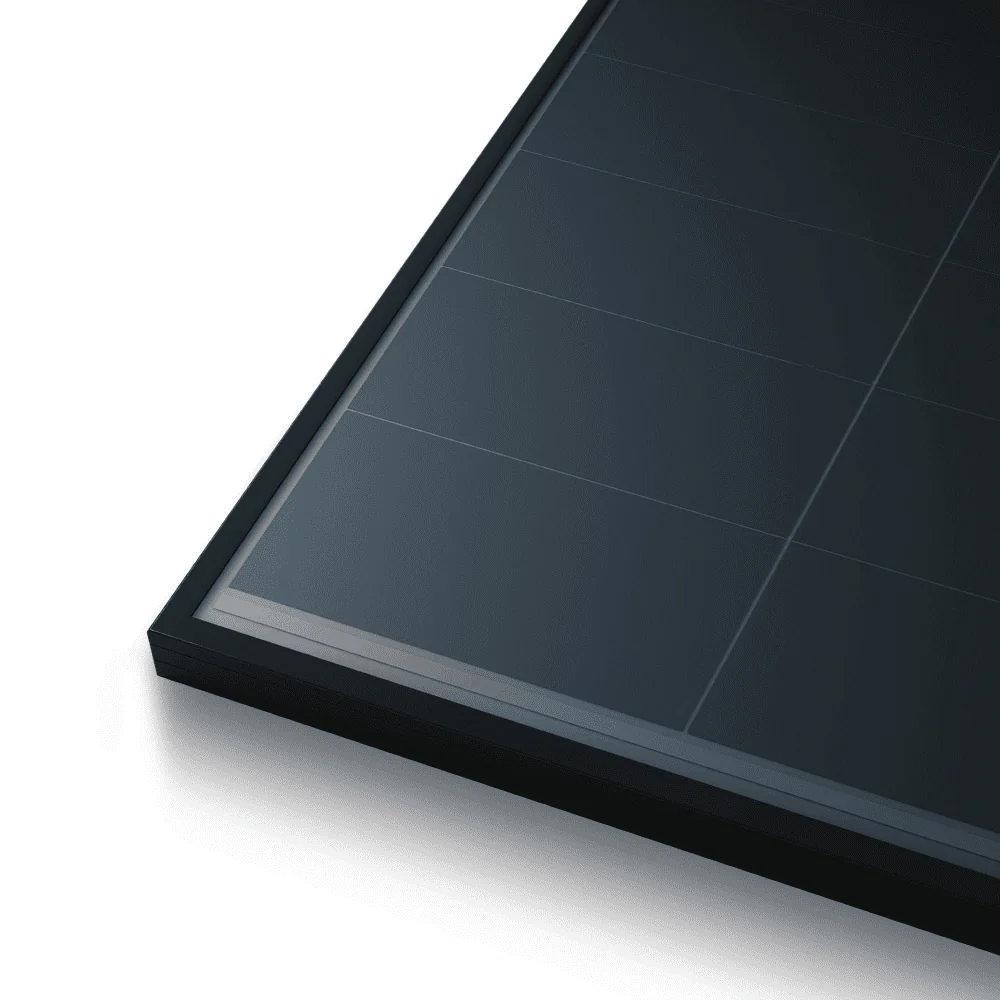
Gen 3 introduces Precision Overlap Soldering, a manufacturing innovation that eliminates the small inactive gaps between adjacent cells that are present in all previous generations. Each cell's edge slightly overlaps its neighbour, maximising the active generating area within the panel's fixed 1,762 × 1,134mm footprint. Combined with hidden rear conductors, this delivers both the increase in electrical output and the seamless all-black appearance that distinguishes Gen 3 from any earlier AIKO module.
Industry-Leading Temperature Coefficient: -0.26%/°C
All solar panels lose output as their operating temperature rises above 25°C — the standard test condition. The rate of that loss is the temperature coefficient of Pmax. At -0.26%/°C, the Neostar 3S has the best (lowest) temperature coefficient independently validated in CEA PV Tech lab tests across all commercially available residential modules. On a hot summer afternoon when a UK rooftop panel might reach 55–65°C, the Neostar is producing measurably more power than a standard PERC panel with a typical -0.35%/°C coefficient — a difference of roughly 2–4% in real operating conditions.
Micro-Crack Resistance
Conventional solar cells are brittle wafers that can develop micro-cracks from mechanical stress — during installation, transport, or under cyclic thermal and wind loading in service. AIKO's cell interconnection method, which distributes mechanical stress across multiple rear contact points rather than concentrating it at front busbars, provides superior micro-crack resistance. Micro-cracks that do form are less likely to propagate to performance-affecting cell fractures, supporting the module's long-term output retention.
True All-Black Aesthetic — Bezel-Less Design
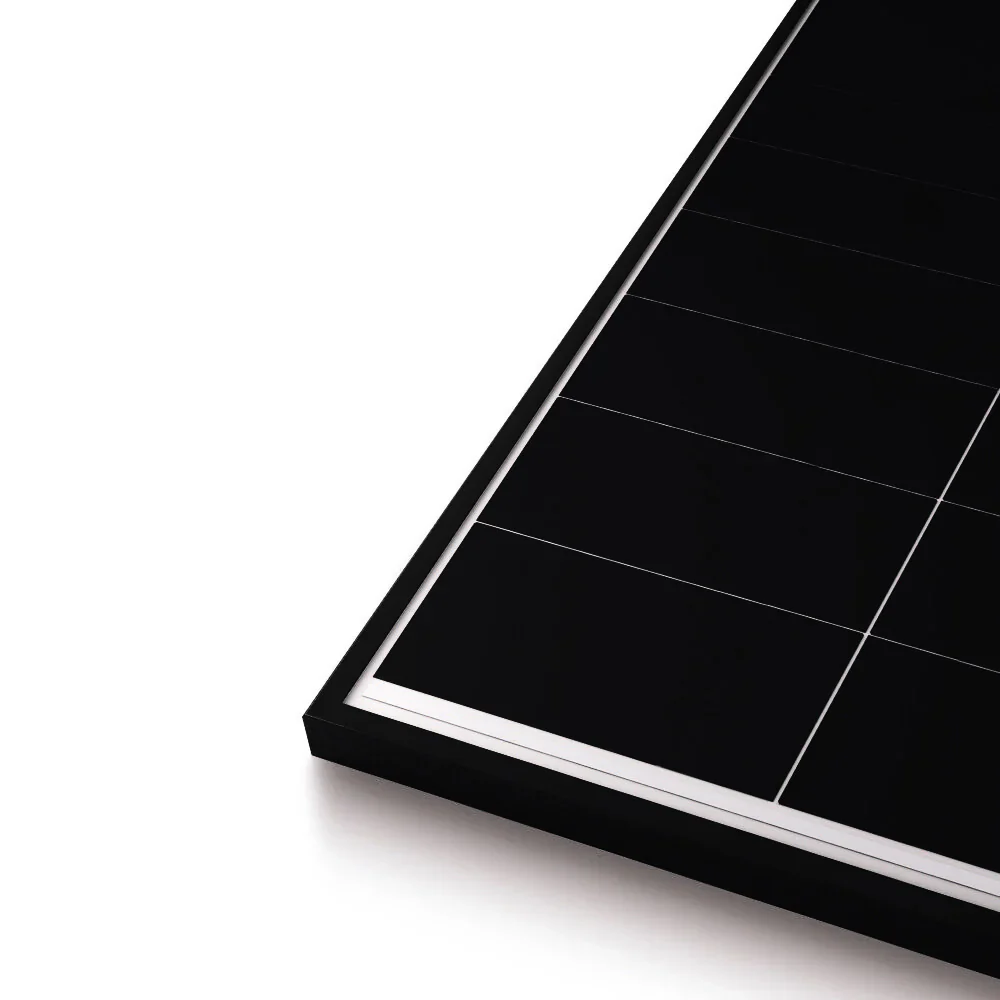
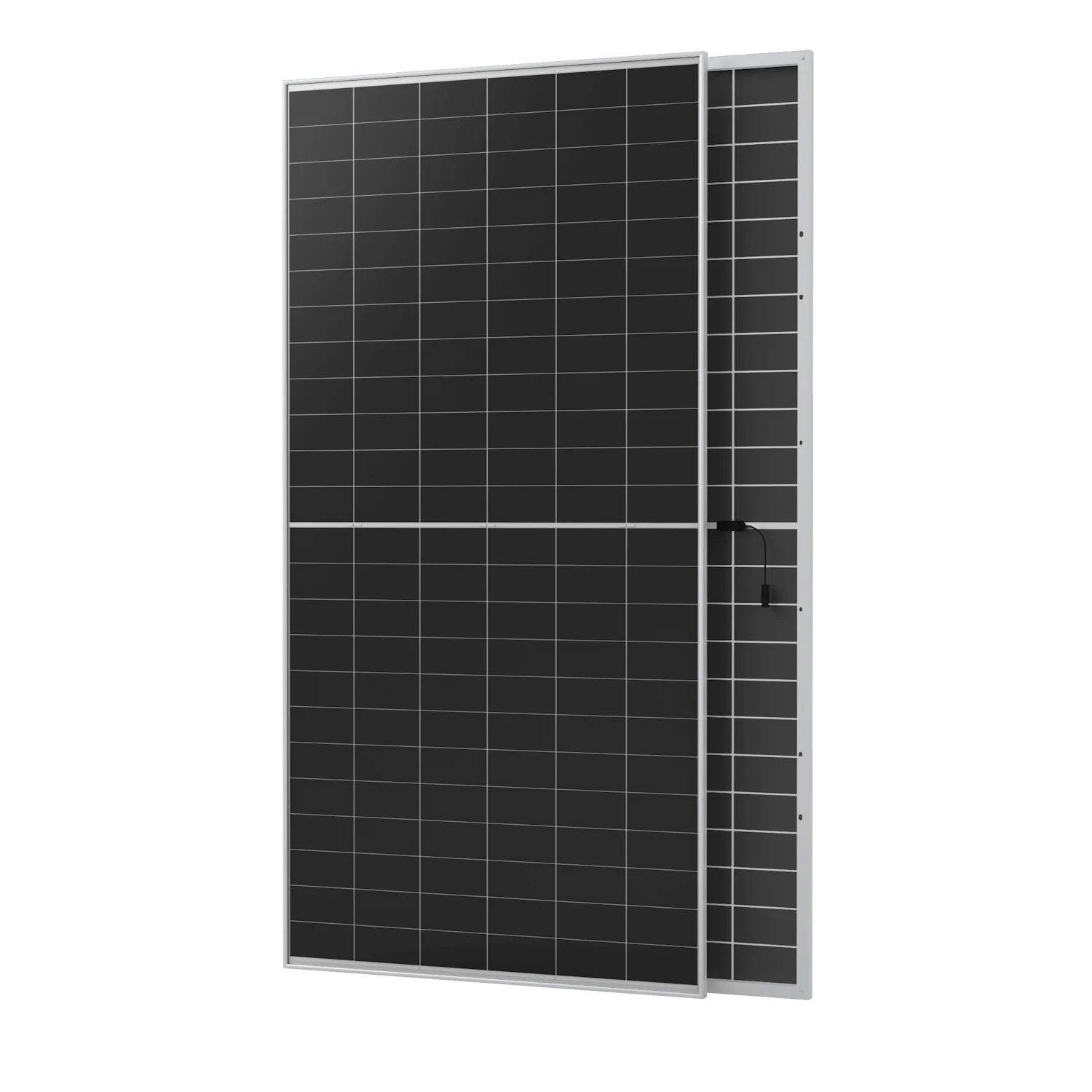
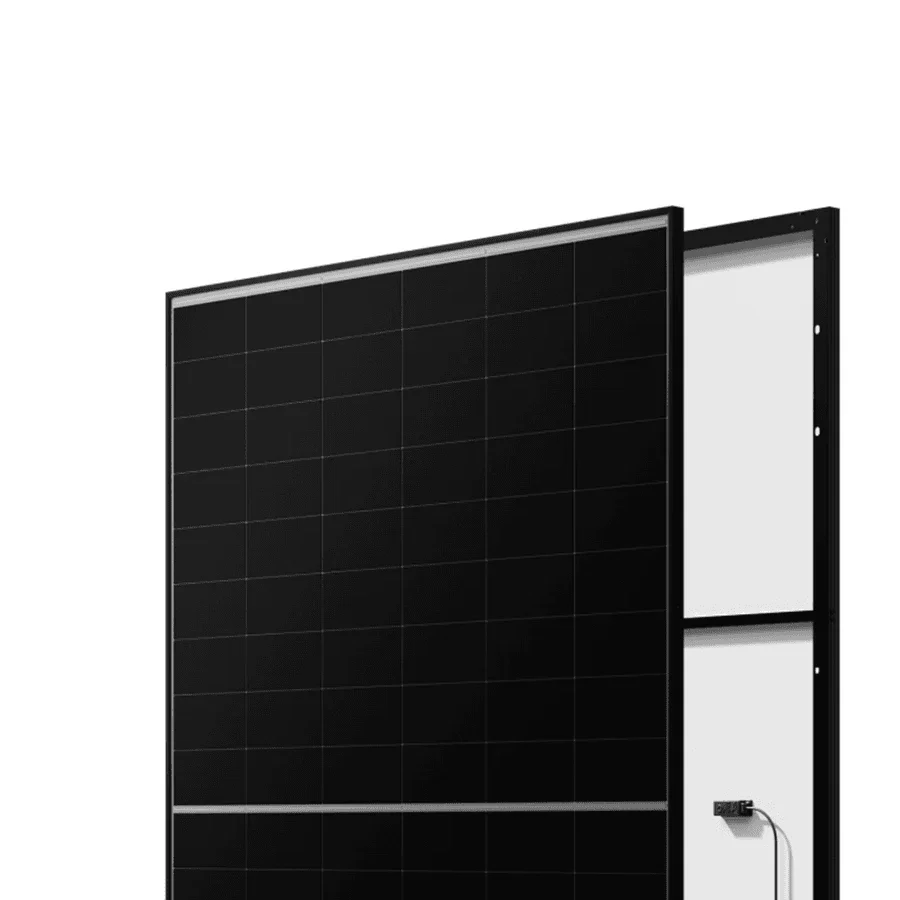
With no front busbars, no silver ribbons crossing the cell surface, a black anodised aluminium frame and black backsheet, the Neostar 3S presents a genuinely uniform black appearance. Unlike panels described as "all-black" that retain visible silver or grey contact lines, the AIKO's front surface has no metallic traces to reflect light or interrupt the dark colour. The bezel-less edge finish means the panel sits flush against the roofline without a visible silver lip — an aesthetic quality that matters for planning permission on period properties and for homeowners who want panels that complement rather than dominate the roof.
Robust Mechanical Specification
The 3.2mm tempered glass front, aluminium frame and +5,400Pa / -2,400Pa static load rating mean the Neostar 3S comfortably handles the wind uplift and snow load conditions encountered on UK rooftops. Hail resistance is tested to 25mm diameter at 23m/s — significantly above the European standard test requirement — and the IP68-rated junction box with 3 bypass diodes is rated for immersion, not merely rain exposure.
Electrical Specifications (Datasheet Verified)
STC: AM1.5, 1,000 W/m², 25°C | NOCT: AM1.5, 800 W/m², 20°C, 1 m/s | Power tolerance: 0 / +3%
| Parameter | STC Value | NOCT Value |
|---|---|---|
| Rated Power (Pmax) | 480 W | 364 W |
| Module Efficiency | 24.0% | — |
| Open-Circuit Voltage (Voc) | 40.80 V | 38.71 V |
| Max Power Voltage (Vmp) | 34.20 V | 32.45 V |
| Short-Circuit Current (Isc) | 14.82 A | 11.97 A |
| Max Power Current (Imp) | 14.04 A | 11.22 A |
Temperature & Ratings
| Temp. Coefficient of Pmax | -0.26%/°C |
| Temp. Coefficient of Voc | -0.22%/°C |
| Temp. Coefficient of Isc | +0.05%/°C |
| Operating Temperature Range | -40°C to +85°C |
| Max System Voltage | DC 1500V |
| Max Series Fuse Rating | 25A |
| Max Static Load (front / rear) | +5,400 Pa / -2,400 Pa |
| Hail Resistance | 25mm diameter at 23 m/s |
| Fire Rating | IEC Class C |
| Protection Class | Class II |
Physical & Mechanical Specifications
| Dimensions (L × W × D) | 1,762 × 1,134 × 30 mm (±2mm L/W) |
| Weight | 21 kg (±3%) |
| Cell Type | N-Type ABC (All Back Contact) |
| Number of Cells | 108 (6 × 18) |
| Front Glass | 3.2mm tempered glass |
| Backsheet | High weather-resistant backsheet (black) |
| Frame | Black anodised aluminium |
| Junction Box | IP68, 3 bypass diodes |
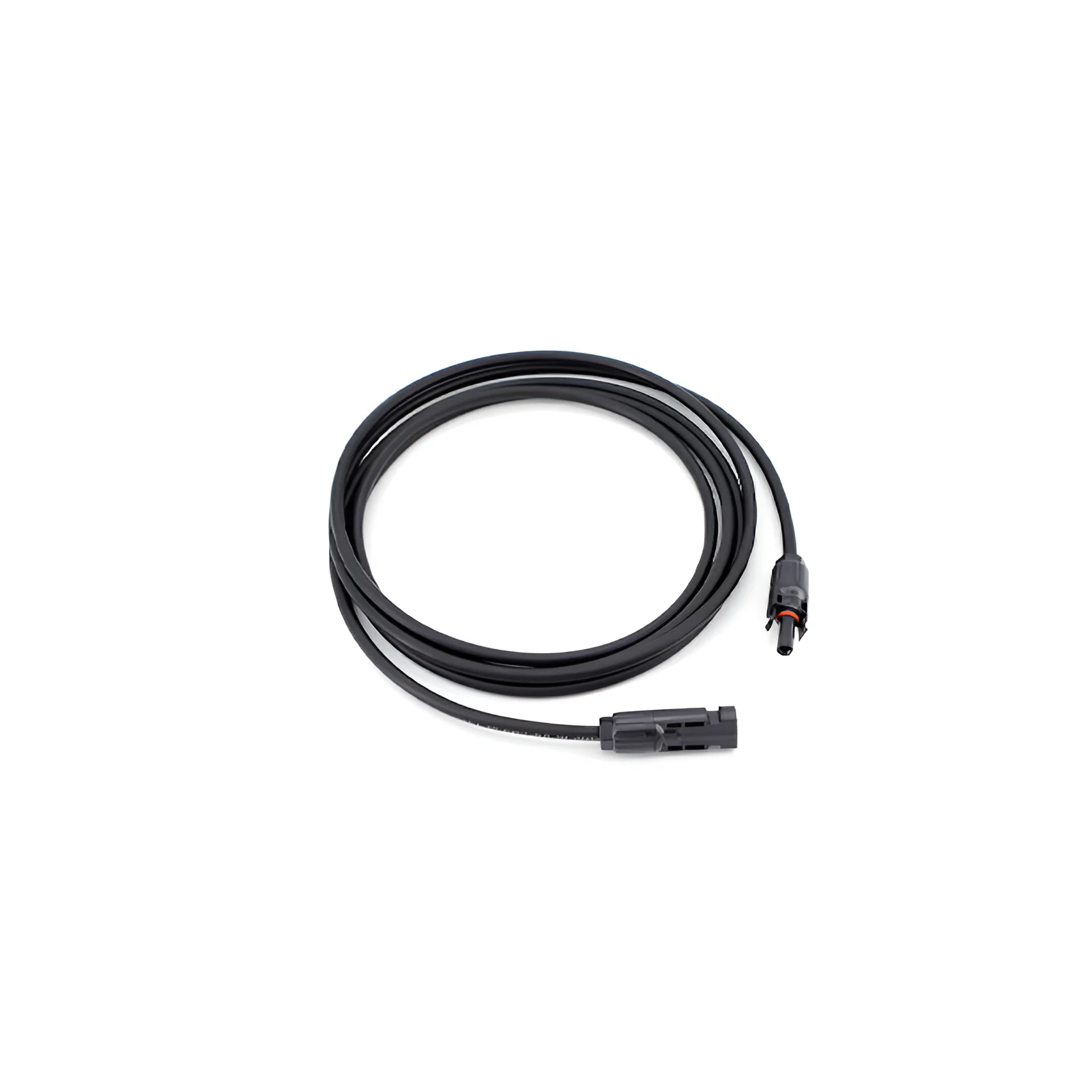
| Cable | 4mm² (IEC), ±1,200mm length |
| Connector | MC4-EVO2 (Stäubli) |
| Clamp Position | Long side only |
| Pallet Quantity | 37 panels per pallet |
| MPN | AIK-A-MCE54-480-AB-G3 / AIKO-A480-MCE54Mb |
| MCS Reference | MR 50677721 0001/1072 |
Warranty
| Product (Materials & Workmanship) Warranty | 25 years |
| Linear Performance Warranty | 30 years |
| Year 1 Minimum Output | ≥99% (≤1% first-year degradation) |
| Annual Degradation (Year 2–30) | ≤0.35% per year |
| Year 10 Guaranteed Output | ≥96.0% of rated power |
| Year 25 Guaranteed Output | ≥88.85% of rated power |
| Year 30 Guaranteed Output | ≥90.6% of rated power |
Installation Notes
The Neostar 3S 480W must be clamped on the long side only — short-side clamping is not permitted and will void the warranty. Standard mid-clamp and end-clamp rail mounting systems are compatible provided they engage the long-side frame. The 4mm² MC4-EVO2 (Stäubli) connectors are compatible with all mainstream MC4-compatible inverters and optimisers; MC4-EVO2 connectors should be mated with EVO2-compatible counterparts for correct IP68 sealing.
For string inverter design: Voc at -10°C should be calculated using the -0.22%/°C Voc temperature coefficient to ensure the string voltage remains within the inverter's maximum input voltage at minimum UK winter temperatures. With a STC Voc of 40.80V, typical UK string sizing calculations should use a Voc correction factor for -10°C ambient.
The high Imp of 14.04A at STC should be verified against the MPPT current limit of the chosen inverter — particularly relevant for hybrid and battery-coupled systems with lower MPPT input current ratings.
Frequently Asked Questions
What does "ABC" mean and why does it matter?
ABC stands for All Back Contact. It means all the electrical contacts — the metal conductors that collect the current generated by the cell — are located on the rear surface of the cell rather than the front. Because there are no busbars or ribbons crossing the front face, the entire surface area is available to absorb light. This structural advantage is the reason AIKO ABC panels achieve higher efficiency than PERC, HJT or TOPCon panels of the same size, and it is also why the cell-level shade tolerance is better — partial shading of one cell does not force a bypass diode to sacrifice an entire string.
Why does the product say "54 cell" when the datasheet says 108 cells?
AIKO's naming convention refers to the number of physical ABC wafers (54), each of which is subdivided into two electrically active half-cells — giving 108 total contact points in a 6×18 arrangement. This is standard AIKO product nomenclature and not an error. The electrical characteristics in the specification table above reflect the full 108-cell module as confirmed in the official datasheet.
Is this panel MCS listed for Smart Export Guarantee (SEG) eligibility?
Yes. The AIKO Neostar 3S 480W Gen 3 is MCS listed (MCS Reference: MR 50677721 0001/1072). Systems installed by an MCS-accredited installer using MCS-listed components qualify for Smart Export Guarantee payments from licensed energy suppliers. Always confirm MCS listing status with your installer before purchase as certification details can be updated.
How does the Gen 3 compare to the Gen 2 Neostar?
Gen 3 introduces Precision Overlap Soldering, which eliminates inactive cell gaps and increases the active generating area within the same panel footprint. This delivers a 15–20W per panel uplift in rated power (and equivalent system-level gain of 15–20kW for a typical UK domestic array) versus the Gen 2 equivalent. The aesthetic is also improved — the overlap soldering removes visible cell borders for a more uniform black surface, and the frame profile is bezel-less.
Is the clamp position important?
Yes — this is a critical installation requirement. The Neostar 3S must be clamped on the long sides of the frame only. Mounting clamps placed on the short sides are not permitted and will void the manufacturer's warranty. Confirm this with your installer and mounting system supplier before ordering racking hardware.
What inverters are compatible?
The Neostar 3S 480W is compatible with all mainstream string inverters (GivEnergy, SolarEdge, Huawei, SMA, Fronius, Growatt, Solis, etc.) and micro-inverter or optimiser systems. Key parameters to verify during system design are: maximum input voltage (Voc × number of panels in series, corrected for minimum site temperature using the -0.22%/°C coefficient); MPPT current limit (Imp is 14.04A at STC — check inverter MPPT input current rating); and maximum system voltage (DC 1500V).
Product Information
Product Information
Shipping & Returns
Shipping & Returns
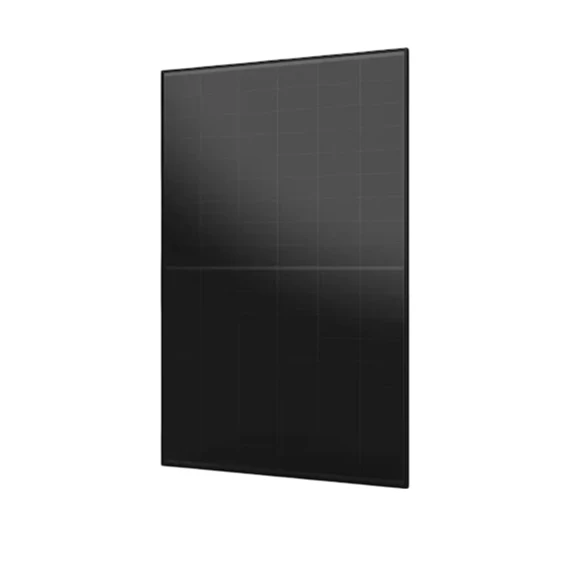
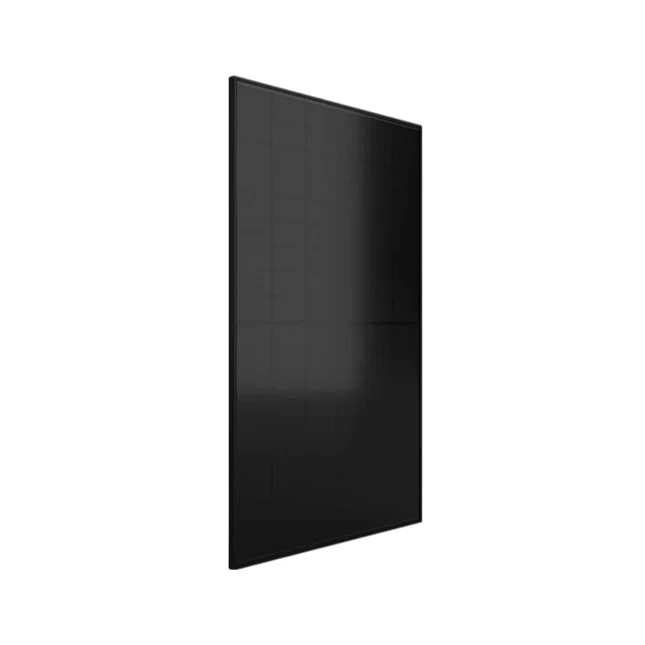
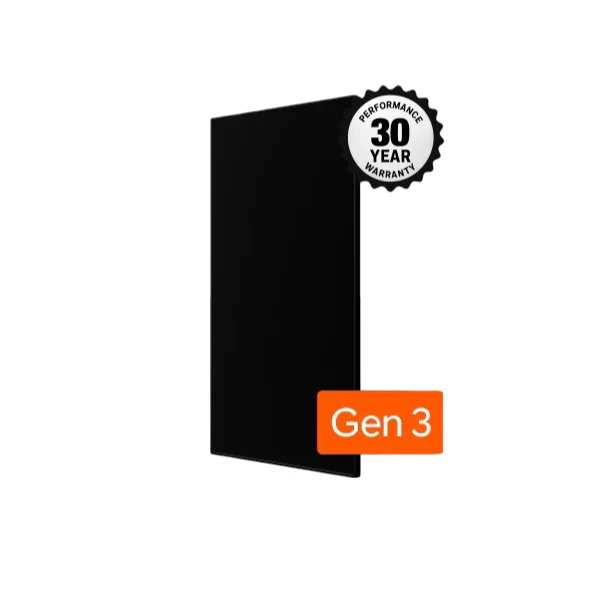
Aiko Neostar Solar Panel 3S 480W N-Type ABC, 54 Cell, Mono Glass All Black, Gen 3
Aiko Neostar Solar Panel 3S 480W N-Type ABC, 54 Cell, Mono Glass All Black, Gen 3
AIKO Solar | MPN: AIK-A-MCE54-480-AB-G3 | MCS Reference: MR 50677721 0001/1072
The AIKO Neostar 3S 480W Gen 3 is the latest iteration of AIKO's all-back-contact N-type solar module — a panel that holds a genuine claim to the highest module efficiency commercially available for residential rooftop use. At 24.0% efficiency from a 1,762 × 1,134mm footprint, it produces more power per square metre than virtually any other panel in its class, making it the natural choice for rooftops where space is limited and maximum output is the priority.
Gen 3 introduces two key technical advances over the previous generation: Precision Overlap Soldering, which eliminates the inactive gaps between cells that reduce usable area on conventional modules; and a fully bezel-less all-black front surface that combines with hidden rear conductors to create a panel that is both visually distinctive and electrically superior. The result is a 15–20kW uplift at system level compared to Gen 2 — not from a larger panel, but from better use of the same roof footprint.
MCS listed and shipped from UK stock, the Neostar 3S 480W is compatible with all mainstream string inverters and qualifying battery storage systems for SEG tariff and Smart Export Guarantee eligibility.
What Makes AIKO ABC Different
All Back Contact (ABC) Cell Architecture
In a conventional solar cell, the metal contacts that collect electrical current run across the front surface — blocking a portion of the incoming light. In AIKO's ABC design, all electrical contacts are moved to the rear of the cell. The entire front surface is available for light absorption, with no busbar shading losses whatsoever. This is the fundamental reason for the Neostar's industry-leading efficiency — it is not a marginal improvement, but a structural advantage over every busbar-based technology including PERC, HJT and TOPCon.
N-Type Silicon – Lower Degradation by Design
N-type silicon is inherently free from light-induced degradation (LID), the performance loss that affects P-type cells in the first months of operation. AIKO guarantees first-year degradation of no more than 1%, followed by no more than 0.35% per year from year 2 onwards — reaching a guaranteed minimum of 90.6% of rated output at year 30. Over the full warranty period this translates to meaningfully more lifetime energy yield than a panel with a higher first-year degradation or steeper annual decline.
Cell-Level Partial Shade Optimisation — Unique to AIKO
Conventional string diode bypass protection operates at the cell-string level — when one string is shaded, the bypass diode sacrifices the entire string to protect the circuit. AIKO's ABC architecture enables partial shade optimisation at individual cell level, meaning shading from a chimney, aerial, tree branch or soiling only affects the specific cells that are shaded, rather than triggering a bypass across a larger section of the module. This is unique to ABC technology and is the reason AIKO panels consistently outperform datasheet expectations in real-world UK conditions, where partial shading is common.
Precision Overlap Soldering — Gen 3 Exclusive
Gen 3 introduces Precision Overlap Soldering, a manufacturing innovation that eliminates the small inactive gaps between adjacent cells that are present in all previous generations. Each cell's edge slightly overlaps its neighbour, maximising the active generating area within the panel's fixed 1,762 × 1,134mm footprint. Combined with hidden rear conductors, this delivers both the increase in electrical output and the seamless all-black appearance that distinguishes Gen 3 from any earlier AIKO module.
Industry-Leading Temperature Coefficient: -0.26%/°C
All solar panels lose output as their operating temperature rises above 25°C — the standard test condition. The rate of that loss is the temperature coefficient of Pmax. At -0.26%/°C, the Neostar 3S has the best (lowest) temperature coefficient independently validated in CEA PV Tech lab tests across all commercially available residential modules. On a hot summer afternoon when a UK rooftop panel might reach 55–65°C, the Neostar is producing measurably more power than a standard PERC panel with a typical -0.35%/°C coefficient — a difference of roughly 2–4% in real operating conditions.
Micro-Crack Resistance
Conventional solar cells are brittle wafers that can develop micro-cracks from mechanical stress — during installation, transport, or under cyclic thermal and wind loading in service. AIKO's cell interconnection method, which distributes mechanical stress across multiple rear contact points rather than concentrating it at front busbars, provides superior micro-crack resistance. Micro-cracks that do form are less likely to propagate to performance-affecting cell fractures, supporting the module's long-term output retention.
True All-Black Aesthetic — Bezel-Less Design
With no front busbars, no silver ribbons crossing the cell surface, a black anodised aluminium frame and black backsheet, the Neostar 3S presents a genuinely uniform black appearance. Unlike panels described as "all-black" that retain visible silver or grey contact lines, the AIKO's front surface has no metallic traces to reflect light or interrupt the dark colour. The bezel-less edge finish means the panel sits flush against the roofline without a visible silver lip — an aesthetic quality that matters for planning permission on period properties and for homeowners who want panels that complement rather than dominate the roof.
Robust Mechanical Specification
The 3.2mm tempered glass front, aluminium frame and +5,400Pa / -2,400Pa static load rating mean the Neostar 3S comfortably handles the wind uplift and snow load conditions encountered on UK rooftops. Hail resistance is tested to 25mm diameter at 23m/s — significantly above the European standard test requirement — and the IP68-rated junction box with 3 bypass diodes is rated for immersion, not merely rain exposure.
Electrical Specifications (Datasheet Verified)
STC: AM1.5, 1,000 W/m², 25°C | NOCT: AM1.5, 800 W/m², 20°C, 1 m/s | Power tolerance: 0 / +3%
| Parameter | STC Value | NOCT Value |
|---|---|---|
| Rated Power (Pmax) | 480 W | 364 W |
| Module Efficiency | 24.0% | — |
| Open-Circuit Voltage (Voc) | 40.80 V | 38.71 V |
| Max Power Voltage (Vmp) | 34.20 V | 32.45 V |
| Short-Circuit Current (Isc) | 14.82 A | 11.97 A |
| Max Power Current (Imp) | 14.04 A | 11.22 A |
Temperature & Ratings
| Temp. Coefficient of Pmax | -0.26%/°C |
| Temp. Coefficient of Voc | -0.22%/°C |
| Temp. Coefficient of Isc | +0.05%/°C |
| Operating Temperature Range | -40°C to +85°C |
| Max System Voltage | DC 1500V |
| Max Series Fuse Rating | 25A |
| Max Static Load (front / rear) | +5,400 Pa / -2,400 Pa |
| Hail Resistance | 25mm diameter at 23 m/s |
| Fire Rating | IEC Class C |
| Protection Class | Class II |
Physical & Mechanical Specifications
| Dimensions (L × W × D) | 1,762 × 1,134 × 30 mm (±2mm L/W) |
| Weight | 21 kg (±3%) |
| Cell Type | N-Type ABC (All Back Contact) |
| Number of Cells | 108 (6 × 18) |
| Front Glass | 3.2mm tempered glass |
| Backsheet | High weather-resistant backsheet (black) |
| Frame | Black anodised aluminium |
| Junction Box | IP68, 3 bypass diodes |
| Cable | 4mm² (IEC), ±1,200mm length |
| Connector | MC4-EVO2 (Stäubli) |
| Clamp Position | Long side only |
| Pallet Quantity | 37 panels per pallet |
| MPN | AIK-A-MCE54-480-AB-G3 / AIKO-A480-MCE54Mb |
| MCS Reference | MR 50677721 0001/1072 |
Warranty
| Product (Materials & Workmanship) Warranty | 25 years |
| Linear Performance Warranty | 30 years |
| Year 1 Minimum Output | ≥99% (≤1% first-year degradation) |
| Annual Degradation (Year 2–30) | ≤0.35% per year |
| Year 10 Guaranteed Output | ≥96.0% of rated power |
| Year 25 Guaranteed Output | ≥88.85% of rated power |
| Year 30 Guaranteed Output | ≥90.6% of rated power |
Installation Notes
The Neostar 3S 480W must be clamped on the long side only — short-side clamping is not permitted and will void the warranty. Standard mid-clamp and end-clamp rail mounting systems are compatible provided they engage the long-side frame. The 4mm² MC4-EVO2 (Stäubli) connectors are compatible with all mainstream MC4-compatible inverters and optimisers; MC4-EVO2 connectors should be mated with EVO2-compatible counterparts for correct IP68 sealing.
For string inverter design: Voc at -10°C should be calculated using the -0.22%/°C Voc temperature coefficient to ensure the string voltage remains within the inverter's maximum input voltage at minimum UK winter temperatures. With a STC Voc of 40.80V, typical UK string sizing calculations should use a Voc correction factor for -10°C ambient.
The high Imp of 14.04A at STC should be verified against the MPPT current limit of the chosen inverter — particularly relevant for hybrid and battery-coupled systems with lower MPPT input current ratings.
Frequently Asked Questions
What does "ABC" mean and why does it matter?
ABC stands for All Back Contact. It means all the electrical contacts — the metal conductors that collect the current generated by the cell — are located on the rear surface of the cell rather than the front. Because there are no busbars or ribbons crossing the front face, the entire surface area is available to absorb light. This structural advantage is the reason AIKO ABC panels achieve higher efficiency than PERC, HJT or TOPCon panels of the same size, and it is also why the cell-level shade tolerance is better — partial shading of one cell does not force a bypass diode to sacrifice an entire string.
Why does the product say "54 cell" when the datasheet says 108 cells?
AIKO's naming convention refers to the number of physical ABC wafers (54), each of which is subdivided into two electrically active half-cells — giving 108 total contact points in a 6×18 arrangement. This is standard AIKO product nomenclature and not an error. The electrical characteristics in the specification table above reflect the full 108-cell module as confirmed in the official datasheet.
Is this panel MCS listed for Smart Export Guarantee (SEG) eligibility?
Yes. The AIKO Neostar 3S 480W Gen 3 is MCS listed (MCS Reference: MR 50677721 0001/1072). Systems installed by an MCS-accredited installer using MCS-listed components qualify for Smart Export Guarantee payments from licensed energy suppliers. Always confirm MCS listing status with your installer before purchase as certification details can be updated.
How does the Gen 3 compare to the Gen 2 Neostar?
Gen 3 introduces Precision Overlap Soldering, which eliminates inactive cell gaps and increases the active generating area within the same panel footprint. This delivers a 15–20W per panel uplift in rated power (and equivalent system-level gain of 15–20kW for a typical UK domestic array) versus the Gen 2 equivalent. The aesthetic is also improved — the overlap soldering removes visible cell borders for a more uniform black surface, and the frame profile is bezel-less.
Is the clamp position important?
Yes — this is a critical installation requirement. The Neostar 3S must be clamped on the long sides of the frame only. Mounting clamps placed on the short sides are not permitted and will void the manufacturer's warranty. Confirm this with your installer and mounting system supplier before ordering racking hardware.
What inverters are compatible?
The Neostar 3S 480W is compatible with all mainstream string inverters (GivEnergy, SolarEdge, Huawei, SMA, Fronius, Growatt, Solis, etc.) and micro-inverter or optimiser systems. Key parameters to verify during system design are: maximum input voltage (Voc × number of panels in series, corrected for minimum site temperature using the -0.22%/°C coefficient); MPPT current limit (Imp is 14.04A at STC — check inverter MPPT input current rating); and maximum system voltage (DC 1500V).
Product Information
Product Information
Shipping & Returns
Shipping & Returns
Description
AIKO Solar | MPN: AIK-A-MCE54-480-AB-G3 | MCS Reference: MR 50677721 0001/1072
The AIKO Neostar 3S 480W Gen 3 is the latest iteration of AIKO's all-back-contact N-type solar module — a panel that holds a genuine claim to the highest module efficiency commercially available for residential rooftop use. At 24.0% efficiency from a 1,762 × 1,134mm footprint, it produces more power per square metre than virtually any other panel in its class, making it the natural choice for rooftops where space is limited and maximum output is the priority.
Gen 3 introduces two key technical advances over the previous generation: Precision Overlap Soldering, which eliminates the inactive gaps between cells that reduce usable area on conventional modules; and a fully bezel-less all-black front surface that combines with hidden rear conductors to create a panel that is both visually distinctive and electrically superior. The result is a 15–20kW uplift at system level compared to Gen 2 — not from a larger panel, but from better use of the same roof footprint.
MCS listed and shipped from UK stock, the Neostar 3S 480W is compatible with all mainstream string inverters and qualifying battery storage systems for SEG tariff and Smart Export Guarantee eligibility.
What Makes AIKO ABC Different
All Back Contact (ABC) Cell Architecture
In a conventional solar cell, the metal contacts that collect electrical current run across the front surface — blocking a portion of the incoming light. In AIKO's ABC design, all electrical contacts are moved to the rear of the cell. The entire front surface is available for light absorption, with no busbar shading losses whatsoever. This is the fundamental reason for the Neostar's industry-leading efficiency — it is not a marginal improvement, but a structural advantage over every busbar-based technology including PERC, HJT and TOPCon.
N-Type Silicon – Lower Degradation by Design
N-type silicon is inherently free from light-induced degradation (LID), the performance loss that affects P-type cells in the first months of operation. AIKO guarantees first-year degradation of no more than 1%, followed by no more than 0.35% per year from year 2 onwards — reaching a guaranteed minimum of 90.6% of rated output at year 30. Over the full warranty period this translates to meaningfully more lifetime energy yield than a panel with a higher first-year degradation or steeper annual decline.
Cell-Level Partial Shade Optimisation — Unique to AIKO
Conventional string diode bypass protection operates at the cell-string level — when one string is shaded, the bypass diode sacrifices the entire string to protect the circuit. AIKO's ABC architecture enables partial shade optimisation at individual cell level, meaning shading from a chimney, aerial, tree branch or soiling only affects the specific cells that are shaded, rather than triggering a bypass across a larger section of the module. This is unique to ABC technology and is the reason AIKO panels consistently outperform datasheet expectations in real-world UK conditions, where partial shading is common.
Precision Overlap Soldering — Gen 3 Exclusive
Gen 3 introduces Precision Overlap Soldering, a manufacturing innovation that eliminates the small inactive gaps between adjacent cells that are present in all previous generations. Each cell's edge slightly overlaps its neighbour, maximising the active generating area within the panel's fixed 1,762 × 1,134mm footprint. Combined with hidden rear conductors, this delivers both the increase in electrical output and the seamless all-black appearance that distinguishes Gen 3 from any earlier AIKO module.
Industry-Leading Temperature Coefficient: -0.26%/°C
All solar panels lose output as their operating temperature rises above 25°C — the standard test condition. The rate of that loss is the temperature coefficient of Pmax. At -0.26%/°C, the Neostar 3S has the best (lowest) temperature coefficient independently validated in CEA PV Tech lab tests across all commercially available residential modules. On a hot summer afternoon when a UK rooftop panel might reach 55–65°C, the Neostar is producing measurably more power than a standard PERC panel with a typical -0.35%/°C coefficient — a difference of roughly 2–4% in real operating conditions.
Micro-Crack Resistance
Conventional solar cells are brittle wafers that can develop micro-cracks from mechanical stress — during installation, transport, or under cyclic thermal and wind loading in service. AIKO's cell interconnection method, which distributes mechanical stress across multiple rear contact points rather than concentrating it at front busbars, provides superior micro-crack resistance. Micro-cracks that do form are less likely to propagate to performance-affecting cell fractures, supporting the module's long-term output retention.
True All-Black Aesthetic — Bezel-Less Design
With no front busbars, no silver ribbons crossing the cell surface, a black anodised aluminium frame and black backsheet, the Neostar 3S presents a genuinely uniform black appearance. Unlike panels described as "all-black" that retain visible silver or grey contact lines, the AIKO's front surface has no metallic traces to reflect light or interrupt the dark colour. The bezel-less edge finish means the panel sits flush against the roofline without a visible silver lip — an aesthetic quality that matters for planning permission on period properties and for homeowners who want panels that complement rather than dominate the roof.
Robust Mechanical Specification
The 3.2mm tempered glass front, aluminium frame and +5,400Pa / -2,400Pa static load rating mean the Neostar 3S comfortably handles the wind uplift and snow load conditions encountered on UK rooftops. Hail resistance is tested to 25mm diameter at 23m/s — significantly above the European standard test requirement — and the IP68-rated junction box with 3 bypass diodes is rated for immersion, not merely rain exposure.
Electrical Specifications (Datasheet Verified)
STC: AM1.5, 1,000 W/m², 25°C | NOCT: AM1.5, 800 W/m², 20°C, 1 m/s | Power tolerance: 0 / +3%
| Parameter | STC Value | NOCT Value |
|---|---|---|
| Rated Power (Pmax) | 480 W | 364 W |
| Module Efficiency | 24.0% | — |
| Open-Circuit Voltage (Voc) | 40.80 V | 38.71 V |
| Max Power Voltage (Vmp) | 34.20 V | 32.45 V |
| Short-Circuit Current (Isc) | 14.82 A | 11.97 A |
| Max Power Current (Imp) | 14.04 A | 11.22 A |
Temperature & Ratings
| Temp. Coefficient of Pmax | -0.26%/°C |
| Temp. Coefficient of Voc | -0.22%/°C |
| Temp. Coefficient of Isc | +0.05%/°C |
| Operating Temperature Range | -40°C to +85°C |
| Max System Voltage | DC 1500V |
| Max Series Fuse Rating | 25A |
| Max Static Load (front / rear) | +5,400 Pa / -2,400 Pa |
| Hail Resistance | 25mm diameter at 23 m/s |
| Fire Rating | IEC Class C |
| Protection Class | Class II |
Physical & Mechanical Specifications
| Dimensions (L × W × D) | 1,762 × 1,134 × 30 mm (±2mm L/W) |
| Weight | 21 kg (±3%) |
| Cell Type | N-Type ABC (All Back Contact) |
| Number of Cells | 108 (6 × 18) |
| Front Glass | 3.2mm tempered glass |
| Backsheet | High weather-resistant backsheet (black) |
| Frame | Black anodised aluminium |
| Junction Box | IP68, 3 bypass diodes |
| Cable | 4mm² (IEC), ±1,200mm length |
| Connector | MC4-EVO2 (Stäubli) |
| Clamp Position | Long side only |
| Pallet Quantity | 37 panels per pallet |
| MPN | AIK-A-MCE54-480-AB-G3 / AIKO-A480-MCE54Mb |
| MCS Reference | MR 50677721 0001/1072 |
Warranty
| Product (Materials & Workmanship) Warranty | 25 years |
| Linear Performance Warranty | 30 years |
| Year 1 Minimum Output | ≥99% (≤1% first-year degradation) |
| Annual Degradation (Year 2–30) | ≤0.35% per year |
| Year 10 Guaranteed Output | ≥96.0% of rated power |
| Year 25 Guaranteed Output | ≥88.85% of rated power |
| Year 30 Guaranteed Output | ≥90.6% of rated power |
Installation Notes
The Neostar 3S 480W must be clamped on the long side only — short-side clamping is not permitted and will void the warranty. Standard mid-clamp and end-clamp rail mounting systems are compatible provided they engage the long-side frame. The 4mm² MC4-EVO2 (Stäubli) connectors are compatible with all mainstream MC4-compatible inverters and optimisers; MC4-EVO2 connectors should be mated with EVO2-compatible counterparts for correct IP68 sealing.
For string inverter design: Voc at -10°C should be calculated using the -0.22%/°C Voc temperature coefficient to ensure the string voltage remains within the inverter's maximum input voltage at minimum UK winter temperatures. With a STC Voc of 40.80V, typical UK string sizing calculations should use a Voc correction factor for -10°C ambient.
The high Imp of 14.04A at STC should be verified against the MPPT current limit of the chosen inverter — particularly relevant for hybrid and battery-coupled systems with lower MPPT input current ratings.
Frequently Asked Questions
What does "ABC" mean and why does it matter?
ABC stands for All Back Contact. It means all the electrical contacts — the metal conductors that collect the current generated by the cell — are located on the rear surface of the cell rather than the front. Because there are no busbars or ribbons crossing the front face, the entire surface area is available to absorb light. This structural advantage is the reason AIKO ABC panels achieve higher efficiency than PERC, HJT or TOPCon panels of the same size, and it is also why the cell-level shade tolerance is better — partial shading of one cell does not force a bypass diode to sacrifice an entire string.
Why does the product say "54 cell" when the datasheet says 108 cells?
AIKO's naming convention refers to the number of physical ABC wafers (54), each of which is subdivided into two electrically active half-cells — giving 108 total contact points in a 6×18 arrangement. This is standard AIKO product nomenclature and not an error. The electrical characteristics in the specification table above reflect the full 108-cell module as confirmed in the official datasheet.
Is this panel MCS listed for Smart Export Guarantee (SEG) eligibility?
Yes. The AIKO Neostar 3S 480W Gen 3 is MCS listed (MCS Reference: MR 50677721 0001/1072). Systems installed by an MCS-accredited installer using MCS-listed components qualify for Smart Export Guarantee payments from licensed energy suppliers. Always confirm MCS listing status with your installer before purchase as certification details can be updated.
How does the Gen 3 compare to the Gen 2 Neostar?
Gen 3 introduces Precision Overlap Soldering, which eliminates inactive cell gaps and increases the active generating area within the same panel footprint. This delivers a 15–20W per panel uplift in rated power (and equivalent system-level gain of 15–20kW for a typical UK domestic array) versus the Gen 2 equivalent. The aesthetic is also improved — the overlap soldering removes visible cell borders for a more uniform black surface, and the frame profile is bezel-less.
Is the clamp position important?
Yes — this is a critical installation requirement. The Neostar 3S must be clamped on the long sides of the frame only. Mounting clamps placed on the short sides are not permitted and will void the manufacturer's warranty. Confirm this with your installer and mounting system supplier before ordering racking hardware.
What inverters are compatible?
The Neostar 3S 480W is compatible with all mainstream string inverters (GivEnergy, SolarEdge, Huawei, SMA, Fronius, Growatt, Solis, etc.) and micro-inverter or optimiser systems. Key parameters to verify during system design are: maximum input voltage (Voc × number of panels in series, corrected for minimum site temperature using the -0.22%/°C coefficient); MPPT current limit (Imp is 14.04A at STC — check inverter MPPT input current rating); and maximum system voltage (DC 1500V).